
Finding an EA role in 2026 is a challenge, even for the most experienced among us. The market has shifted. Hiring standards have changed. What employers want from an Executive Assistant today is often very different from what was expected even a few years ago. If you’ve been job hunting recently, you’re not imagining it. It feels harder because it is.
I’ve been hearing from Executive Assistants across the globe who are struggling to land interviews, let alone offers, which I know is soul-destroying. Some are being ghosted, more than once – both from recruiters and from the organizations themselves. Others are told they’re too experienced or not strategic enough. Many EAs are applying for roles that aren’t even labelled as Executive Assistant positions anymore, because organizations are playing around with the job descriptions and job titles. They are not even sure what they want in their Assistant roles.
Since, the findings were released in Q4 of 2025, we’ve reviewed the EA Salary Survey from Alicia Fairclough and Yvette Pearson and gathered insights from the EA Campus community and LinkedIn. This article on finding an EA role in 2026 pulls together what I’ve learnt so far and what you can do to stay competitive in what seems to be a ridiculously fast-paced and uncertain landscape.
Today, this is what we’ll cover:
Why the market feels so tough right now
How the Executive Assistant role is evolving
Key findings from the 2025 EA Salary Survey
Where we’re seeing growth in Executive Assistant hiring
What you can do to improve your job search results
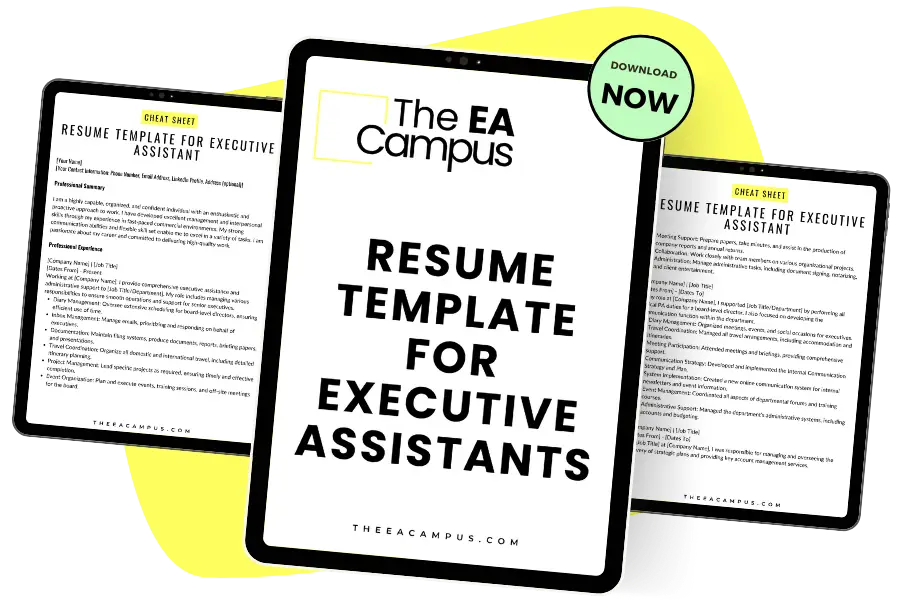
This template covers everything you need to get your resume in front of the right recruiters and employers. It is a free downloadable PDF; you can adapt it to create the perfect resume for your career history.
Finding an EA role in 2026 has become more complex for many reasons. Where do we start? I don’t want you to feel disheartened if you have been searching for a new role for a while, but I do want you to know the realities of your search. Because there are simply fewer Executive Assistant positions available compared to five or ten years ago.
Since 2000, approximately 1.6 million administrative jobs have disappeared in the US, and another 20% decline in Executive Assistant roles is projected over the next five years. We’re seeing the same trend across the UK as well. It’s a pretty universal issue because of a number of factors we’ll look at, but if you’re aiming at finding an EA role in 2026, this is the context you need to understand.
There are a few reasons behind this. First, many organizations have restructured how support roles operate. Rather than hiring one EA per Executive, it’s now common for a single Assistant to support multiple leaders or even entire departments (we’ve seen EAs support upwards of 10 Execs – and this is far from uncommon). This shift, which has steadily become the norm, reduces the headcount of EAs in any one organization but, as we know, increases complexity and scope for the EAs who remain. When an EA leaves, organizations often wait months to backfill the role, absorb the tasks into a team structure, or hand over more work to the remaining EAs rather than hire again.
Secondly, the rise of automation and AI has, or should I say, the marketing of those tools has had a significant impact on the role of the EA. Many many organizations believe technology can help them reduce overheads and increase profits. There has been a huge explosion of software on the market that promises to reduce administrative work, reduce repetitive tasks, and replace your Assistant (or question why you even need to hire one in the first place). On the flip side, in some companies, Executives, particularly those outside the C-suite, are expected to handle these tasks themselves, with support from AI tools.
But as EAs, we know the reality doesn’t quite match the hype. Some of the AI tools on the market are great, specifically around certain tasks, but some have quite a way to go before they can effectively complete the task from start to finish, and of course, many of the tasks still require context, judgment, and adaptability – things that automation and AI can’t deliver. That said, the belief that automation can replace traditional EA work has taken hold in many boardrooms and hiring practices. Software companies have done a very good job of convincing leaders that AI can do what we do, and we need to be aware of that when seeking a new EA role in 2026.
So even if the tech doesn’t fully deliver, the perception that it might has real consequences. Organizations are investing in new software rather than new hires, particularly for entry-level roles (such as receptionist or admin positions, which are often stepping stones to an Assistant role), and the expectations have shifted – for those roles being advertised, most of them are very tech-heavy, and EAs need to adapt and learn these new tools.
We can’t ignore the genuine progress in automation either. Tools like AI assistants, meeting schedulers, and automated expense systems are improving and are replacing some administrative tasks. As Executive Assistants, we need to be honest about what can be automated, understand how to automate our work, be well-informed about those tools, really to a point where we can teach others, and ensure we’re focusing on the parts of our work that can’t be automated, where we now start to add value.
The rise of remote and hybrid work has also had an impact. Most EAs prefer a hybrid role that allows them to work from home or have some flexibility in their schedule. Those roles are available but highly sought after. With some organizations wanting their workforce full-time back in the office, you might have to compromise on this one. And actually, the smart move might be to go into the office full-time to secure a full-time role in 2026. If you want to go fully remote in 2026, there are lots of opportunities for VAs and fractional EAs, but again, they attract significantly more applications, often from across the globe. That means you could be competing with 200+ other candidates for a single role. And when the job description requires project delivery, AI fluency, and experience with systems like Slack, Notion, or ChatGPT, even well-qualified candidates risk being overlooked if they don’t highlight the right skills in their resumes or during the interview process. To improve your chances of finding an EA role in 2026, your application needs to be more targeted than ever.
Finding an EA role in 2026 is still achievable, but the dynamics have changed, and it takes time and a huge amount of patience. There are fewer jobs, more complexity, and a longer list of expectations. Also, let’s not forget that the hiring process has been completely transformed over the last few years with the introduction of AI. What does that mean for EAs?

Finding an EA role in 2026 now involves navigating a hiring process that has changed significantly. Today’s recruitment experience can feel like a job in itself, and I’ve heard many EAs say it is draining, frustrating, and unpleasant.
Candidates now face multi-stage interview processes that often stretch across three to five rounds. It’s no longer unusual to go through several interviews before even meeting the Executive you’ll be supporting. In many cases, the first few steps are handled by HR or external recruiters, with the Executive only coming into the process at the very end. That’s not that different from a few years ago, but we now also have rounds of AI-led screening before we meet anyone from the organization (which we’ll get to). For those of us who actually want to meet the person we’ll be working closely with, this delay can make it harder to demonstrate what we bring to the table or even decide whether we want the role. But this is now part of the process for finding an EA role in 2026.
As I mentioned, you’ll likely also encounter AI-led screening. It’s becoming common for companies to ask candidates to complete one-way video interviews using platforms that record your answers to pre-set questions. The responses are then analyzed by AI for clarity, tone, and communication strength. These interviews are often followed by live video calls, sometimes more than one, before you get the chance to meet someone face-to-face. It can feel impersonal and frustrating because, after going through these rounds, I’ve heard many EAs say they receive no feedback, and more often than not, they don’t even get a reply from the recruiter or the organization. Many EAs have shared how difficult it is to build a connection in this environment, but right now, this is how many hiring pipelines are designed. It makes you wonder how many roles are being lost in the recruitment industry.
There’s also a rise in skills testing. Employers want to see what you can do, not just hear about it. That might mean completing a scheduling or inbox triage task, delivering a short presentation, or answering scenario-based questions under time pressure. These assessments are typically added later in the process, but can still take a few hours to complete. It must feel like massive overkill, especially if you are an EA with extensive experience, and, again, there is often no feedback or response to these tests. Yet, they’ve become a standard way to assess how you think and operate, even if they are not in any way personal. Finding an EA role in 2026 means being prepared to showcase your skills in action.
LinkedIn is playing an even bigger role, too. In both the US and the UK, most EA roles are now advertised or sourced directly through LinkedIn. Recruiters use it to scan for talent, check your digital profile, and reach out to potential candidates. One report suggests that 95% of recruiters use LinkedIn regularly, and six people are hired through the platform every minute. That’s a lot. So if you’re serious about finding an EA role in 2026, you really can’t afford to ignore LinkedIn and all that comes with it (updating profile, posting, etc.).
The hiring process can feel exhausting or soul-destroying, as one EA in our community called it. It’s much longer, more tech-heavy, and less personal than many of us would like. But, and it pains me to say it, it’s also not going away. The best way through is to understand what’s coming, prepare accordingly, and keep your perspective, because it will feel like a tick-box exercise most of the time, and that you are jumping through hoops to get an interview, but if you do see it as a process, you’ll be better prepared, and you can refine your approach as you go.
Finding an EA role in 2026 doesn’t look like it did five years ago. But that doesn’t mean it’s out of reach. Keep going, enter the process knowing what to expect, and don’t let your confidence waver. We are in a state of rapid change, and what you are experiencing is not unique to you.
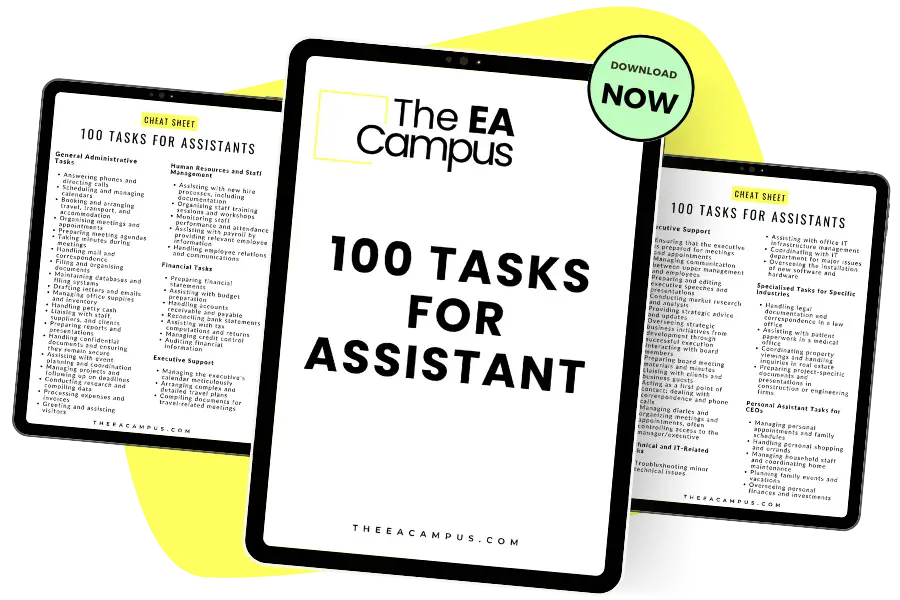
This List of Tasks for Executive Assistants Download helps you recall and record every task you handle, supports you in writing polished CVs and precise job descriptions, and recognises additional responsibilities you can undertake.
Although it might feel like the right approach, and I wouldn’t blame you if you’ve been looking for a new role for a while, finding an EA role in 2026 doesn’t mean applying for every job that comes up. There is demand for EA roles in specific sectors, so I suggest you focus your efforts there and tailor your resume accordingly.
Some sectors in both the US and the UK are actively hiring Executive Assistants, even as other industries slow. Tech, healthcare, finance, and high-growth startups continue to invest in strong operational support, but as I’m sure you know, they are in high demand. In environments where executives are under pressure to deliver more, faster, they need strategic support to execute.
So what does that mean for EAs?
First, if you are pursuing those roles, you have to get your ducks in a row. Every resume you send must match the job description; you can’t send a blanket resume and assume your experience will stand out on the page. It won’t, because your resume is being run through AI software trained to extract keywords; it won’t be seen by a human until it’s been filtered down to a handful of candidates.
Your resume has to go beyond the basic skill set; every EA will have those skills. You need to tie your skills to the problems and challenges you can support, and again, that must be specific and tailored to the Exec you will support and the organization itself.
Skills in AI tools, automation platforms, and systems like Notion, Airtable, and Slack integrations are moving from “nice to have” to expected. Data analysis and reporting are now part of how EAs demonstrate impact. One recent report showed that 44% of employers say digital skills are now a top-three requirement when hiring for EA roles. That number is only going up.
There’s also a growing trend of internal promotions. Executive Assistants who take on special projects, lead initiatives, or contribute to cross-functional goals are being promoted or moved around because the hiring process is so time-consuming. Many of these roles never make it to public job boards; they’re offered internally to standout EAs who’ve proven themselves.
If you’re serious about finding an EA role in 2026, these are the spaces to watch, prepare for, and position yourself in.
Finding an EA role in 2026 means we’re dealing with a job market that’s more strategic, more tech-driven, and more competitive than ever. Executive Assistant roles are still out there – and still well paid. But we know the expectations have shifted. So if you’re serious about finding an EA role in 2026, you need to refresh how you present yourself and your career. From the research I’ve done, these suggestions seem to be making a difference.
Refresh your resume and LinkedIn to focus on results.
Make your achievements impossible to miss. Write about your skills or the tasks you manage differently. You’ve made things better, faster, and smoother, so showcase those aspects of your role. Instead of listing duties, show outcomes. For example, instead of “managed calendars,” say “streamlined Executive scheduling to reduce conflicts and increase planning capacity by 25%.” If you made something better, say how. Add numbers when you can. Finding an EA role in 2026 means showing exactly where you’ve made a difference.
Be very specific about the tools you use.
If you’ve used tech tools, list them. Hiring managers and AI software are scanning for keywords like Microsoft Copilot, Slack, ChatGPT, Notion, Asana, Power BI, and Zapier. Don’t just mention them, talk about how you used them. Did you use Zapier to automate reporting? Did you introduce Notion to your team? This shows you’re not just aware of the technology, you’re applying it. Finding an EA role in 2026 gets easier when your skills jump off the screen.
Broaden your search terms.
EA roles are popping up under different titles. Think Executive Business Partner, Administrative Business Partner, Operations Analyst, Business Manager, and even Chief of Staff. If you’re only searching for Executive Assistant, or derivatives of the title (Personal Assistant, Administrative Professional), you’ll miss some brilliant opportunities. Job titles have changed, but the core work hasn’t, so just match your resume to the different job titles and hit send. You want to catch every role that fits. Finding an EA role in 2026 means getting smart with your search terms.
Treat rejections as useful data.
No one loves being told no. But if you didn’t get the job, try to find out who did. Keep an eye on the company’s LinkedIn page and filter for new EA hires. When you spot them have a look at their profile. What tools did they list? What tone did they use? Was their experience broader or more tech-driven? Use that info. Adjust your own CV and LinkedIn. Each no can bring you closer to a yes – especially if you tweak based on what you have learnt.
Get interview-ready with impact stories.
You need to be able to say what you did – and why it mattered. Build out a few STAR stories (Situation, Task, Action, Result). You reorganized your Executive’s calendar? Great. What happened because of that? Did they save time? Were priorities clearer? Pick 3–5 real examples from your work that show you made a difference. Hiring managers want impact and results, and I hate to say it, but you need to sell your career in those terms. Finding an EA role in 2026 means being ready to say: here’s what I did, and here’s what changed.
Think like a strategic partner.
The term strategic partner got a bad rap last year, even to the point I saw some LinkedIn posts suggesting EAs shouldn’t be strategic anymore. In its simplest terms, being strategic means planning ahead. That is literally what strategy means. The EA role is fundamentally a role designed to plan ahead, and being strategic is a core skill. Yes, we all know that part of our role is to take tasks from others and act on those orders; that isn’t going away. But our roles don’t stop there. We spot problems, bring ideas, and help execs work better. Show this in your interviews. Ask smart questions. Show that you’re thinking beyond the day-to-day. We need to speak to the bigger picture. Finding an EA role in 2026 depends on showing we can add real business value.
Make LinkedIn work for you.
Finding an EA role in 2026 almost always includes LinkedIn. Recruiters are constantly searching there. Your profile should tell a clear story. Use keywords that match today’s EA job posts. Share examples of tools, impact, and strategy. If you’ve taken part in a course or masterclass – share it. Over 122 million people have landed interviews through LinkedIn. It’s worth making your profile count.
Keep learning, even while applying.
If you’ve got time between applications, spend some of it learning. There are brilliant free and low-cost resources out there. Courses on AI tools, tech platforms, scheduling, and project management – all of it adds value. Mention them on your resume. Bring them up in interviews. Finding an EA role in 2026 favors the assistant who is still learning, still adapting, still engaged.
We know it’s tough out there. The hiring process is longer and more time-consuming, and feedback is rare. Roles don’t always match the title, and there are still plenty of shady recruiters, jobs, and organizations that take advantage of Executive Assistants. But we’re also seeing Assistants land brilliant roles – ones that are more strategic, better paid, and offer more flexibility than ever before.
Finding an EA role in 2026 will take effort. But it’s not out of reach. We’re evolving, and so is the profession.
Share this article:
Join 30,000+ Assistants receiving our carefully crafted weekly newsletter packed with valuable tips, tricks, and insights tailored specifically for Assistants like you.