
Raise your hand if you’ve ever felt guilty at work. Now, this is an article, so I can’t actually see any hands—but I bet many of you have done just that. Guilt and the EA role go hand in hand more often than we’d like to admit. Things you shouldn’t feel guilty for at work remind us that these emotions are common, but they shouldn’t control how we navigate our roles. Understanding guilt and the EA role helps us unpack these emotions and learn how to handle them with clarity.
It’s easy to get caught up in a whirlwind of emotions, especially guilt. But let’s be clear: guilt is natural, and guilt and the EA role shouldn’t define how we operate. Instead, let’s explore how to take control of our mindset and leadership.But let’s be clear: guilt is a natural emotion, and it doesn’t have to dictate how we operate daily. Things you shouldn’t feel guilty for at work give us the tools to better understand these feelings and move forward with confidence.
During a recent EA Campus Virtual Summit, Transformative Leadership Coach Monique Jordan Cave addressed guilt and the EA role, offering practical tools for tackling those guilt gremlins head-on. Her insights resonated deeply with many of us and reinforced how universal these feelings are in our profession. Her insights on things you shouldn’t feel guilty for at work resonated deeply with many of us.
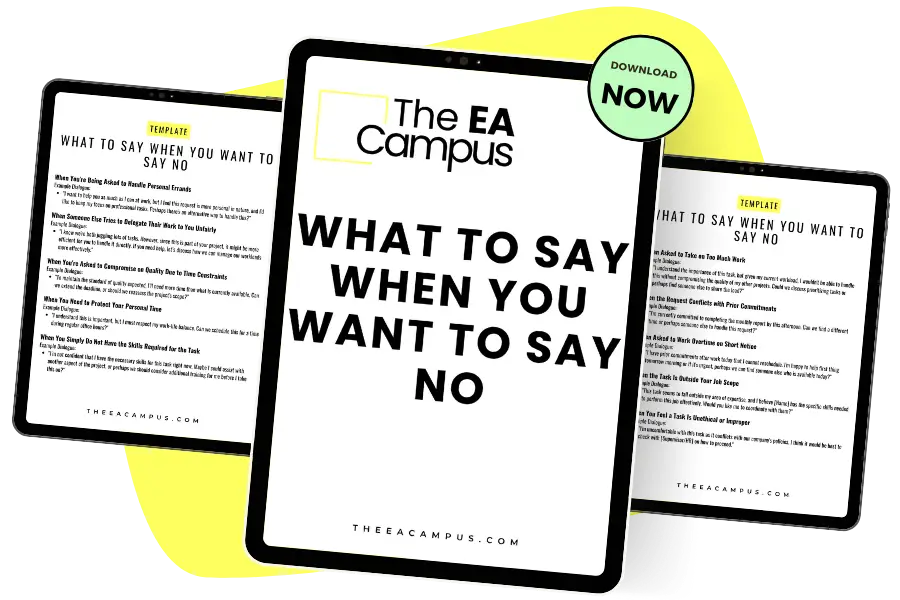
This template provides you with practical, ready-to-use dialogues tailored for various common scenarios where you might need to refuse a request at work. Equip yourself with the right words to handle difficult conversations gracefully.
Achieving success is a testament to your hard work, dedication, and perseverance, especially in the Assistant role, where success often requires overcoming significant challenges. For those of us who have experienced success, we know the journey can sometimes bring out the naysayers—friends, colleagues, or even family members who feel left behind or undervalued. Their insecurities might manifest as jealousy, leaving us feeling guilty about what we’ve achieved. Things you shouldn’t feel guilty for at work encourage us to own our success and let go of that guilt. Achieving success is something to celebrate, yet many of us feel weighed down by it. Guilt and the EA role show up when you land the promotion, receive recognition, or get that long-awaited raise, and then start questioning whether you deserve it.
So, how do we handle success guilt?
Mistakes happen to all of us. Whether it’s missing an email or making a logistical error, it’s essential to remember that we’re human. I know we often hear that making mistakes in the Assistant role is unacceptable, but let’s challenge that notion. If we’re not given the grace to make mistakes, how are we supposed to grow? Things you shouldn’t feel guilty for at work remind us that mistakes are part of the process, and they don’t define us. But guilt and the EA role can make us feel like a single slip-up is the end of the world.

It might feel uncomfortable to admit, but it’s okay not to care about everything that happens at work. As Executive Assistants, our primary focus should be on our responsibilities, our relationships with our executives, and our career growth. If we’re indifferent to workplace drama or feel ready to disconnect at the end of the day, that’s perfectly fine. Things you shouldn’t feel guilty for at work emphasize the importance of setting boundaries and protecting our mental energy. Guilt and the EA role sometimes tell us we need to be everything for everyone, but that’s a fast track to burnout.
End-of-Day Routine: Create a routine to wind down. Organize your workspace, review tasks, and prepare for the next day so you can leave work behind with confidence.
Set a Finish Time: A solid routine limits rumination, which is often triggered by guilt and the EA role.
Realistic Planning: Avoid overloading your plate. Plan your day with a clear understanding of your priorities and limits.
Reframe Your Mindset: Shift your focus to the positive aspects of your life outside of work. It’s okay to prioritize your well-being over workplace distractions.
It’s important to remember that while our jobs are significant, they don’t define who we are—not even as Executive Assistants! Things you shouldn’t feel guilty for at work remind us that we are more than our roles.
Your organization might own the job, but you own your career.
So the next time guilt tries to creep in, remind yourself of your worth, your journey, and your goals. Always remember—you’re doing just fine. Things you shouldn’t feel guilty for at work is a reminder that we’re on a journey of growth, resilience, and self-discovery.
Executive Assistants are often the emotional backbone of their team. We solve problems, absorb stress, and smooth things over. That makes guilt and the EA role a complicated pair. We take on too much, and when we try to pull back, guilt creeps in.
Let’s name it and reframe it.
If you’re struggling with guilt and the EA role, here are practical tips to work through it:
Your organization might own the job, but you own your career. Guilt and the EA role don’t get to decide what success looks like – you do.
Whether it’s saying no, pushing back on unrealistic demands, or choosing not to attend one more meeting, guilt and the EA role can be redefined as part of a healthy professional mindset.
So the next time guilt creeps in, remind yourself:
That’s the truth about guilt and the EA role.
Guilt and the EA role shouldn’t be about trying to be perfect. They should be about understanding what’s healthy, what’s productive, and what’s not yours to carry.
If you want to elevate your skills and mindset as an Assistant, consider enrolling in the Assistant Mindset Online Course at The EA Campus. This course is designed to empower professionals like us to navigate the workplace with confidence and resilience. Don’t let guilt in the EA role hold you back.
Share this article:
Join 30,000+ Assistants receiving our carefully crafted weekly newsletter packed with valuable tips, tricks, and insights tailored specifically for Assistants like you.