
In the last few years, we’ve seen a clear shift in the C-suite. A growing number of executives are leaning into harder, faster, more dominant leadership styles. Many Executive Assistants are seeing Alpha Leadership Styles surface more often in the C-suite as the culture around us shifts. The kind that prioritize decisiveness, speed, and control over collaboration and emotional intelligence. With cultural moments like Mark Zuckerberg declaring that workplaces have become too feminine, paired with high-profile stories of toxic bro cultures in tech (tell that to the wage gap still running through most organizations), it’s easy for that tone to spill over into your own organization and influence how your Executive shows up day to day. When Alpha Leadership Styles take hold, the pace changes before anyone has time to name what’s happening.
For Executive Assistants, this shift isn’t just theoretical. You will feel it immediately. A change in tone. A jump in urgency. Decisions made faster, with less discussion. Expectations rising overnight. If your executive moves into this style. Whether temporarily, as something they want to try out because the culture has shifted, or they always had these tendencies and now they are the new default, the impact will land directly on your desk.
And for many of us, particularly women and those who value balanced, respectful leadership, this will feel really unsettling. The gap between corporate messaging about inclusion and the reality of day-to-day behavior can be stark, and when your Executive starts mirroring that behavior, even unintentionally, you’re going to be the one who feels the change first. It can be disorienting when anyone changes how they behave, but in this instance, it can really go against the culture you want to work in and the Executive you want to align with.
This article is about helping you navigate that shift. How to understand what’s driving it. How to adjust your communication without compromising who you are. How to stay confident and effective when the pace ramps up. And how to recognize the moment when the culture becomes unhealthy, and it’s time to leave.
It goes without saying that it is not your job to control your Executive’s leadership style, but you can control how you respond to it. and how you protect your voice, your boundaries, and your role as a strategic partner in the C-suite. Because alpha leadership styles can look efficient from the outside, but the day-to-day experience for an EA can be anything but.
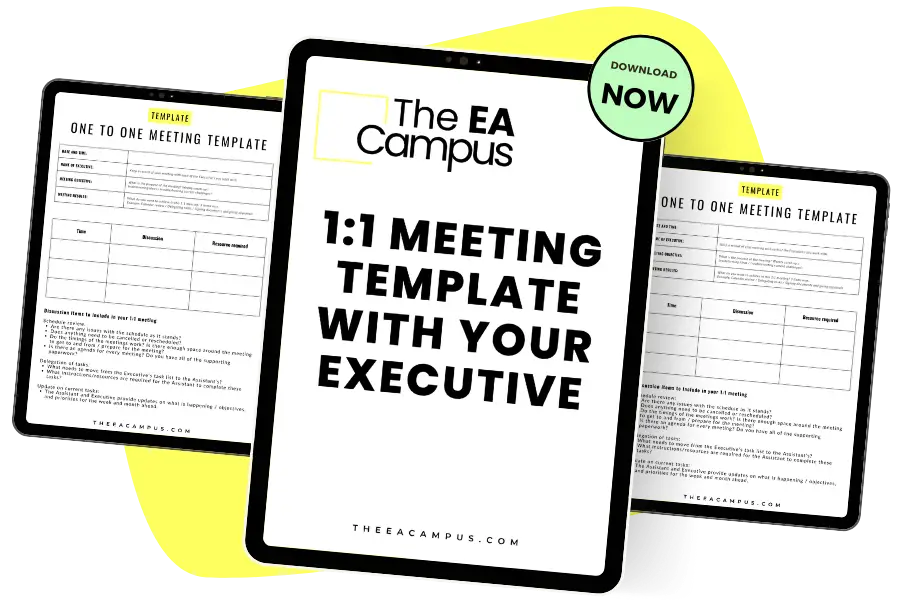
The 1:1 Meeting Template for Executives and Assistants gives you the steps to ensure that when you have a one-to-one meeting with your Executive, you get through all the work you need to cover and maximise your time together.
This shift in behavior isn’t about your Executive suddenly deciding to sharpen their leadership style. It’s bigger than that. It’s part of the cultural moment we’re all operating in. A moment where Executives are being fed the message that dominance, speed, and visible toughness are the markers of effective leadership. When markets feel unstable, and stakeholders want results yesterday. When boards feel nervous. When tech leaders publicly frame aggression and a lack of empathy as a virtue. Executives might start to absorb that message, consciously or not. Some (and I’m far from saying all) start to believe that this is simply how business is done now, and they have to adapt their approach to keep up. One of the toughest parts of alpha leadership styles is figuring out what’s stress-driven and what’s becoming the new normal.
Research helps explain why these shifts can feel so sudden. Sociologist Jennifer Berdahl describes something called “masculinity contest culture,” which shows up in four traits:
As EAs, I know you’ll recognize these traits instantly when they surface in the C-suite. Decisions speed up, patience drops, urgency becomes the default, and there’s an expectation of constant availability. And the tone in which you are asked to do things gets harder, even if the actual content hasn’t changed. What happens ultimately is that work becomes a performance of toughness rather than actual progress.
For Executive Assistants, unfortunately, these traits don’t sit at arm’s length, and you can’t just ignore them. These new ways of working will land right in the middle of your day.
But how does the shift in leadership style manifest itself in your day-to-day? You’ll see it in the small things first. Shorter replies. Sharper requests. Fewer explanations. Priorities change mid‑morning, then again by lunch. You might get half the context you used to, but double the expectations. Meetings that had space for discussion become rapid-fire decisions. And the pace they set for themselves quickly becomes the pace they expect from you.
The other side of this change in leadership style is that you, as the EA, become the first responder, the filter, the translator who has to go out and explain this to your slightly bewildered colleagues. And on tough days, you might also become the person colleagues vent to because they can’t take their frustration directly to the leader.
Understanding where this shift comes from doesn’t excuse poor behavior – far from it. But we can’t all leave our jobs (at least not straight away) because our Exec has embraced a tech bro mindset. What this article aims to do is give you clarity. And clarity is what you need to navigate the change with steadiness and resolve.
When your Executive shifts into a more dominant or high‑intensity style, your first job is to figure out what’s actually changing. It’s rarely just a sharper tone. Often it comes with a dip in empathy, a shorter fuse, or language and behavior that would have raised eyebrows months ago. It could be comments that land badly, jokes that miss the mark, or reactions that feel disproportionate. These aren’t always intentional (and sometimes they really, really are). If unintentional, the behavior is often due to a mix of pressure, insecurity, and a cultural moment that keeps rewarding leaders for being harder, less empathetic, and collaborative. And because this style is being normalized publicly, calling out inappropriate or offensive behavior can feel riskier and more complicated than it should.
So how do you read the change accurately? You need to look for patterns. Is this a temporary spike because of a deadline or stakeholder pressure, or is it settling in as the new leadership style? Are they short with everyone, or only you? Has the way they speak to people changed, or just the pace? Are they cutting off conversations that used to be collaborative? Are they using phrases or jokes they’d never have used six months ago? These small shifts help you understand whether you’re dealing with stress, habit, or a deeper behavioural turn.
It’s also important to distinguish between decisive and domineering. Decisive leadership isn’t a bad thing; decisive leaders are great. Being decisive ultimately speeds up clarity and makes the whole organization move at pace. Domineering leadership, however, is what we need to be concerned about. Domineering leaders shut down dialogue. One helps you work faster. The other makes you second‑guess every interaction. If they’re simply moving quickly, you can adapt your workflow. But if they’re dismissing context, shutting down your input, or using intensity as a way of behaving inconsiderately, that requires a different response.
The clearer you are about the type of shift you’re seeing, the easier it becomes to adjust your own approach without absorbing behaviour you shouldn’t have to carry. Alpha leadership styles can normalize behavior that doesn’t feel respectful, and EAs need to trust their instincts when something feels off.

Once you understand what’s really changing, you can shift how you communicate so you stay effective without feeling like you’re losing your footing.
So the first change you should make to your communication is to be more direct. Start with the point, then add the detail if they actually need it. For example: ‘Board deck is ready. Final version in your inbox.’ rather than a long build‑up explaining how you got there or even any pleasantries. So going forward, just give them the headlines, nd if they need more, you can add some context.
This is something we say for any type of leader you support, but it is worth reiterating with this style of leader. Offer solutions, not problems. So, instead of saying, ‘There’s a clash on Thursday’s schedule,’ try, ‘There’s a clash on Thursday. Option A is to move the investor call to 1pm. Option B is to keep the call and switch the internal review to Friday. I recommend Option A because it protects your prep time.’ With this approach, again, it is straightforward, and you’re not dumping the issue on their desk to resolve – you’re doing that on their behalf.
The next thing to consider is your tone. Use confident, grounded language. You don’t have to be forceful, just be really clear. ‘Here’s what I recommend.’ ‘Here’s the fastest option.’ ‘Here’s what will keep us on track.’ A clear, confident tone cuts through if there’s a lot of noise and posturing. Also, speaking like this leaves little room for those inappropriate ‘jokes’ or offhand remarks that might become more commonplace.
Another skill you can really lean into when working with these types of leaders is anticipating and pre-empting what they need next, because a lot of these leaders think they’ve got it all covered, but, in my experience, they tend to forget the detail. So, if they’re moving quickly, think one or two steps ahead. If they ask for the briefing notes, assume they’ll need the travel, the talking points, and the attendee list too. This reduces back‑and‑forth and keeps you in control of the workflow.
As we said, one of the behaviors in this style of leadership is putting the work first, so they will expect you to match the pace, but for your own sake, you have to do this in a sustainable way. The first place to start is to be on top of your workflow and systems, so you’re not creating your own delays. They don’t need or want the nuance or detail, so use this to your advantage. Keep updates really short. Remove extra explanation. Focus on what actually moves the work forward, and don’t go above or beyond that.
Lastly, and this is an important one, build structured check‑ins. They’re not going to slow down unless you set the expectation. A weekly touchpoint keeps the two of you in alignment, stops short sharp emails or quick exchanges from becoming the only form of communication, and gives you a place to raise concerns before they turn into bigger problems.
Hopefully, you can see that these shifts don’t ask you to imitate their behavior. They position you as the steady point in their day when the culture they are tapping into is telling them to go faster, harder, and with less thought or care. Not all Alpha leadership styles are toxic, but all of them require more intentional communication from you.
If your Executive is shifting into a more dominant style or has bought into the hustle, tech bro culture, it can be quite a change and might impact your confidence, especially if this wasn’t how you were operating or working together. It’s going to be really easy to question things you were completely sure about. So the first thing to say to yourself is that you’re not doing anything wrong; it’s the environment around you that’s changing. If you are seeing these changes, some practical tools will help you navigate this new environment.
I like to use data when having fractious conversations because it keeps the conversation grounded and prevents everything from becoming about tone or interpretation. Part of your role is to ensure everything runs smoothly, and part of this leadership style is disrupting and dismantling norms, so you’ll probably find yourself having to push back if things get really unorganized. For example, in the past, you might have had a conversation that started with you saying, “I don’t think that timeline will work,” and then you’d discuss the best approach. In this new environment, you’re better off saying, “That timeline overlaps with two major deadlines and leaves you with less than 30 minutes of prep. Here are the alternatives.” Can you see the difference? There is less room for disagreement; you’ve stated your case, and they can make the decision. It’s calm, clear, and anchored in facts.
Because at some point, you might have to justify your existence. Really, I know that sounds harsh, but we’ve all heard the Elon Musk story about sacking his EA after she asked for time off (though Musk has since disputed it). There are tons of stories on LinkedIn and in the media about CEOs and entrepreneurs who have built their own AI assistant and no longer require our specific skills. So, for that reason alone, keep a log of everything you handle, and the exercise also keeps your confidence connected to reality rather than your Executive’s mood. Note the decisions you’ve made, the workload you’re carrying, and the impact you’re having. When things get tense, this gives you a baseline. It also gives you something solid to refer back to if you ever need to advocate for yourself.
Talk to other assistants or trusted colleagues who see the same changes and are experiencing the change in culture. Because once the leader starts acting like this, you can be sure others will follow. Yes, you can use this time for a good venting session, but it might also help give you a little perspective. When things feel intense, it’s easy to believe you’re the only one noticing the shift. You’re usually not.
And remind yourself of your role. We support our Executives, but we shouldn’t ever absorb their stress, intensity, or put up with their behaviour when it crosses a line. You don’t need to match their pace or shrink yourself to avoid conflict. Holding your ground is easier said than done, but unfortunately, with these types of individuals, you need to.
If alpha leadership styles are becoming part of your Executive’s approach, it’s important to think about what you will and won’t tolerate. When the inappropriate jokes start creeping in, or the comments feel a little too casual, pause and decide how you want to respond. Sometimes it’s an eye roll and a quick change of subject. Sometimes it’s a direct, ‘Not appropriate,’ said calmly. And sometimes it’s a conversation with HR because it’s gone well past a line. Only you know your tolerance level, and it’s personal to you. But you do have options. You don’t have to just put up with behaviour that makes you uncomfortable or disrespected. For many assistants, navigating alpha leadership styles is less about liking them and more about staying effective within them.
If your Executive starts operating with a harder edge, you’ll feel it before most people do. That’s the reality of our role. Things can feel different fast, and it’s completely normal to need a moment to steady yourself and decide if you want to stay in your role.
What I’ve learned over the years is that this is exactly when our value becomes clearer. We’re the ones who keep things moving when expectations shift with no warning, and everyone is leaning into a hustle culture that doesn’t actually have any substance. Our value in these environments is to bring structure when everything else feels like it’s speeding up just for the sake of it. That consistency matters more than it ever gets credit for.
And working with an alpha-leaning leadership style doesn’t mean you have to mirror it. You don’t have to become louder or tougher to be effective. Stick with what actually works in this role. clear communication, solid judgment, and boundaries you hold without apologizing for them. You don’t have to mirror alpha leadership styles to work well with them; you just need clarity, boundaries, and a realistic plan for how you show up.
Yes, there will be moments where you adapt because it makes the workflow easier. You tighten your updates, you strip out the nuance, you get even sharper about what needs their attention. But you only have to do that with them, you can keep your previous style in place for your colleagues and those around you who do need empathy and a little more detail. And you can also say, ‘This isn’t working for me,’ or ‘That crossed a line,’ when it needs saying. You can bring your Executive back to reality when things start drifting. That’s part of being a good EA too.
And if the environment shifts so far that it no longer aligns with your values, you’re not stuck. You can reset expectations, you can raise concerns, you can ask for support, and you can also quietly explore other options if the role stops being a place where you can grow or really even want to be around. You’re not the only one figuring this out. Plenty of us have navigated these shifts, and you can, too – without losing your self in the process.
Share this article:
Join 30,000+ Assistants receiving our carefully crafted weekly newsletter packed with valuable tips, tricks, and insights tailored specifically for Assistants like you.