Judgement is the most valuable EA skill you have right now, and the odd thing is that the more capable AI becomes, the truer that gets. It sounds backwards, I know. If the tools can draft an email and summarise a meeting, surely the human doing those things matters less? Stay with me, because the research points firmly the other way.
AI is brilliant at one particular thing: prediction. Economists like Ajay Agrawal, writing for the IMF, describe it as a “prediction technology”: a system that reads patterns in data and forecasts the likely next step. So, for example, AI can look at your Executive’s diary and tell you which meeting is most likely to overrun this week, based on how similar meetings have run before.
What it cannot do is decide which of those things matters, or what to do about it. AI cannot weigh a trade-off or work out what “good” looks like when nobody has written it down. That is your job. And as prediction gets cheaper and more accurate, the deciding gets rarer and more valuable by comparison. That is exactly why judgement is the most valuable EA skill as these tools spread through the workplace, rather than a lesser one.
The Boston Consulting Group expects AI to reshape between 50 and 55% of jobs in the US over the next two to three years. That word, reshape, really matters. The consultancy doesn’t expect most of those jobs to be wiped out. They expect the mix of tasks to change: the routine, rule-based tasks get handled by software, and what is left is the interpretive work of reading a situation and choosing what to do about it. For an Assistant, that interpretive work has always been our actual job. What is written on the job spec and the tasks we have change every few years, but the skills that underpin the work have always stayed fairly consistent. Which is another way of saying judgement is the most valuable EA skill precisely because it outlasts every tool that comes along.
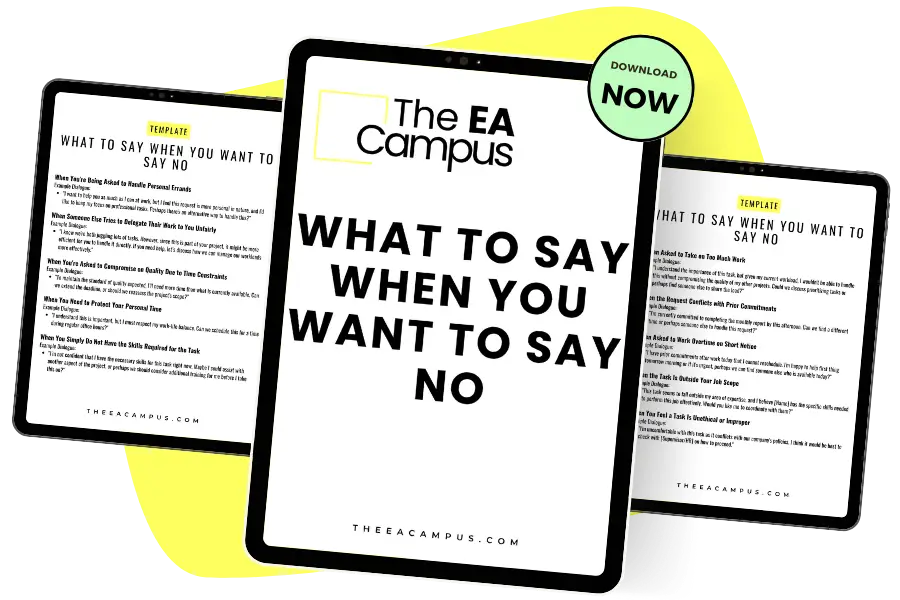
This template provides you with practical, ready-to-use dialogues tailored for various common scenarios where you might need to refuse a request at work. Equip yourself with the right words to handle difficult conversations gracefully.
This is where I want to get concrete, because “judgement” can sound like a grand, once-a-quarter kind of thing. It is not. Judgement is the most valuable EA skill in an ordinary, pretty unglamorous way: it is a hundred small calls a day, most of which nobody ever sees you make.
Here is where judgement is the most valuable EA skill in the ordinary run of a working week:
None of that appears on a job description. All of it is judgement, and it is why judgement is the most valuable EA skill rather than a nice extra you get to once the important work is done. These are the calls that decide whether your Executive’s day stays on track, and because we are using these skills every day, they are taken for granted by us and those around us.
So, here is the catch. The more you let AI do the first-draft thinking for you, the less practice you get at doing it yourself. And that practice is exactly how you built your judgement in the first place.
Judgement is not something you are born with. Sir Andrew Likierman at London Business School describes it as a process, something developed over time, through experience and continued learning. You build it by doing the hard work yourself. Think about the last time two VIPs both wanted the same slot in your Executive’s diary. You had to work out whose meeting mattered more, and how to move one of them without causing offence. Nobody handed you that answer, and working it out for yourself is exactly how your judgement got better. When AI does the first draft of that kind of work for you, yes, the job still gets done, but you won’t get the practice that built your discernment in the first place.
That risk is absolutely higher for newer Assistants. The entry-level tasks that used to teach you the ropes are often the first ones to be automated. As the economist Carl Benedikt Frey warns, if firms hire fewer juniors, train less, and assume the machine will handle the first draft, they erode “the very expertise needed to check the machine’s output.”
So, if you cannot tell a good AI output from a mediocre one, you are effectively just using what it has guessed and more than likely passing it on as your own work to someone more senior who then might pass it even further up the chain.
The good news is that discernment can be practised in the middle of a completely normal working day, here are a few examples of where you can build judgement:
Do this often enough, and it stops being a technique. It becomes the way that you work. And it is the difference between an Assistant who uses AI and one who leans on it for everything.
The Assistants who will matter most over the next few years are the ones who know which of the tool’s answers to trust and which to bin, and who know when to stop typing, pick up the phone, and make a human connection. That is judgement, and it is the one skill these tools make more valuable every single time they get better. So when I say judgement is the most valuable EA skill, I can not emphasise this enough – it is the skill worth putting your time into.
So make sure the people you work for can see you using it. Judgement does not show up in an output the way a finished report does, so this is work worth talking about. Because judgement is a brilliant skill you can bring to the role, and it is going to stay that way long after today’s tools have been replaced by whatever comes next.
Share this article:
Join 30,000+ Assistants receiving our carefully crafted weekly newsletter packed with valuable tips, tricks, and insights tailored specifically for Assistants like you.