
The way we work has changed. Remote roles, hybrid models, freelance contracts, and fractional EA positions are now part of our everyday working life. For us as Executive Assistants, building a strong, trusted partnership with an Executive we rarely see in person brings new challenges. But it also brings new opportunities. Building a Strong Partnership with Your Remote Executive has never been more essential.
In this article, we will explore practical strategies to help you build an exceptional partnership with your remote Executive, using collaboration tools, fresh ways of working, and lessons learned from the rise of remote and hybrid working. Building a strong partnership with your remote Executive starts with small, intentional steps that build trust over time.
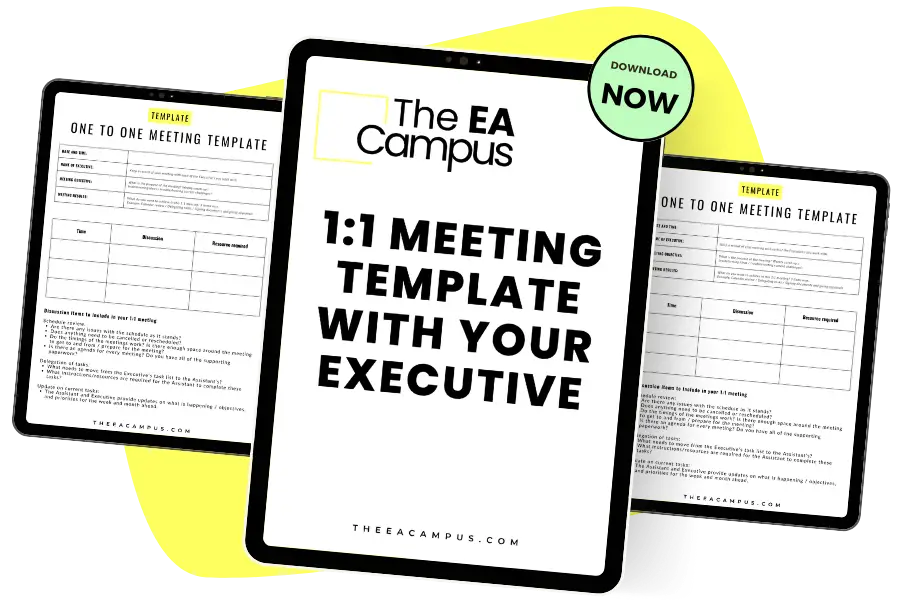
The 1:1 Meeting Template for Executives and Assistants provides the steps to ensure that when you have a one-to-one meeting with your Executive, you cover all the work you need to and maximise your time together.
Every strong partnership starts with understanding. If you are stepping into a new role or working with a new Executive, start as you mean to go on. Building a Strong Partnership with Your Remote Executive means taking the time to build the relationship from day one. If you have been working together for a while, it is never too late to strengthen the partnership. By making small changes and being intentional, your Executive will start to see and feel the difference in how you work together.
Whether you are just starting out or have been working together for some time, it is important to align expectations. Book a meeting focused on how you will work together moving forward. Break the conversation down into a few key areas:
In a remote or hybrid setting, clear communication becomes even more important because you don’t have the benefit of spontaneous conversations or quick office check-ins. Building a strong partnership with your remote Executive starts by asking how they prefer to communicate day-to-day. Do they like quick messages on Slack, detailed emails, phone calls, or scheduled updates? Agree on how you will keep each other in the loop.
If you are working in a hybrid environment, you might find that the style shifts depending on whether you are both in the office or working remotely. In-person days might be better for spontaneous conversations and quick problem-solving, while remote days will need more structured updates and clearly flagged priorities. Having an agreed approach for both situations will help keep building a strong partnership with your remote Executive consistent and effective.
Find out how involved your Executive wants to be in decision-making. Some Executives like to be consulted on everything, while others prefer you to take the lead on routine decisions. In a remote or hybrid setting, this becomes even more important because you do not have the option to quickly pop into their office for a fast check-in.
Building a strong partnership with your remote Executive means having a decision-making framework or hierarchy in place. For example, you might set up three tiers:
Small decisions: These are actions you can take independently without needing to check in first. Examples include ordering office supplies, scheduling internal team meetings, or confirming routine travel arrangements.
Medium decisions: These are actions where you inform your Executive but continue to move forward unless they advise otherwise. Examples could be accepting or declining minor meeting requests on their behalf, adjusting project timelines slightly, or making purchases within an agreed budget.
Major decisions: These require their input before moving forward. Examples include making significant changes to a project plan, committing to external engagements like speaking opportunities, or handling sensitive personnel matters.
Having a clear decision-making process builds your confidence and makes remote working feel more seamless. Building a strong partnership with your remote Executive means making sure they can trust your judgment even from a distance.
Understanding your Executive’s daily rhythm is crucial, especially when you are working remotely or in a hybrid setting. Building a strong partnership with your remote Executive involves knowing when they are most productive, when they prefer meetings, and when they need uninterrupted focus time.
If you are working hybrid, think about how their schedule might differ between office days and remote days. They might be more available for impromptu discussions when in the office, but need stricter boundaries around meetings and communications when working from home.
Also, agree on how often and in what format you will send updates on progress and priorities. Some Executives prefer a daily digest first thing in the morning, while others might want a mid-week round-up or a Friday afternoon wrap-up. Building a strong partnership with your remote Executive means matching your communication style to their needs.
Setting clear agreements around these areas will help you work more smoothly together and avoid misunderstandings.
Create a simple ‘Working Together’ document to capture everything you agree on. This can be a living document that evolves as your partnership grows. Here are some key sections you might include:
Communication Preferences: Best channels to use (email, Slack, text), preferred response times, and guidelines for urgent messages.
Meeting Cadence: Frequency of 1:1s, stand-ups, and check-ins, both virtual and in-person if hybrid.
Decision-Making Framework: Examples of small, medium, and major decisions, and how each type should be handled.
Daily Rhythm Overview: Best times to schedule meetings, when to avoid interruptions, and working hours (especially across different time zones if relevant).
Update and Reporting Style: Format and frequency of updates (daily, weekly, bi-weekly).
Key Contacts: List of core internal and external stakeholders, preferred points of contact, and escalation paths.
Personal Preferences: Important dates, travel habits, dietary requirements, and anything else that supports the personal side of the partnership.
Building a strong partnership with your remote Executive becomes much easier when everything is agreed upon and documented.

When you work remotely, it’s easy to become “invisible.” That’s why it’s crucial to be intentional about visibility and staying in the loop. Building a strong partnership with your remote Executive means actively demonstrating the value you bring to their day and the wider business.
Set up a weekly or biweekly 1:1 meeting with your Executive. Keep your camera on whenever possible and treat this time as sacred for check-ins, alignment, and deepening the relationship. If your Executive is under pressure, suggest shorter “stand-up” meetings that allow you to stay connected without taking up too much of their time.
Share regular updates – not just on what you’ve done, but on the impact those tasks have had. Let them know what you’ve solved, what’s progressing, and where you’ve stepped in to remove a blocker. These small insights help build trust, keep you visible, and highlight your strategic thinking.
Being looped into meetings and ongoing conversations is also key. Proactively ask to attend when appropriate, and make a case for your presence based on what you can contribute and what context you’ll gain. Meet your Executive where they are – use the platforms and tools they already rely on, whether that’s Slack, Microsoft Teams, Zoom, or something else. You don’t need to force new systems; instead, integrate yourself into the ones they use daily. This helps you stay close to the action and demonstrates your ability to adapt to their preferred ways of working.
Over time, your Executive will start to see you not as someone who supports from the sidelines, but as someone who is integral to how they operate, whether that is remotely or in person.
Working remotely means you won’t always get quick answers, and that’s where mastering asynchronous communication becomes essential. Asynchronous communication means you’re not expecting or requiring an immediate response. Instead, you provide clear, thorough updates that your Executive can review when it suits their schedule.
For Executive Assistants, learning how to communicate effectively in an asynchronous way is a game-changer. It allows you to keep projects moving forward without always needing real-time approval or feedback. It also shows that you respect your Executive’s time and workload, which strengthens trust.
Building a strong partnership with your remote Executive involves structuring your updates so they are easy to digest. Keep your messages clear, concise, and action-oriented. A quick weekly email can work well to keep your Executive updated and aligned. Here’s what to include:
Key actions completed: Summarize what tasks and projects you have completed during the week.
Current priorities: List what you’re currently working on and any deadlines you’re tracking.
Upcoming deadlines: Highlight important dates, deliverables, and anything your Executive should be aware of in the coming days.
Wins and successes: Share positive updates and small wins that show momentum and progress.
Challenges and blockers: Flag any issues that could impact timelines or require Executive input.
Requests for decisions or feedback: Clearly state anything that needs their review or approval.
General updates: Include any other updates that provide broader context or information your Executive might find valuable.
Include context where needed, but keep it scannable so your Executive can quickly get the big picture at a glance.
Use tools like Slack, Microsoft Teams, or Asana to stay visible without overwhelming their inbox. When something is urgent, always flag it clearly. Otherwise, keep communication flowing smoothly by giving them the information they need to make decisions when they have time to engage.
Mastering asynchronous communication means you’re always keeping the momentum going, even if your Executive isn’t immediately available. It’s one of the most important skills you can develop in a remote or hybrid role.
Technology is there to make remote partnerships easier, but only if we use it well. Building a strong partnership with your remote Executive means choosing digital tools that support, not disrupt, your day-to-day collaboration.
Start by meeting your Executive where they already are. If they use Slack every day, use Slack. If they prefer working out of their inbox and want everything to come through email, that’s fine too. If they live inside Microsoft Teams or prefer shared folders in Google Drive, great – integrate yourself into those platforms. The key is not to introduce complexity for the sake of it. The best tools are the ones both of you actually use and that keep building a strong partnership with your remote Executive front of mind.
A shared document to manage weekly tasks or a recurring email update might be all you need. On the other hand, if your Executive prefers a dashboard or tool to track projects, consider platforms like Trello, Asana, ClickUp, or Notion. Calendaring tools like Vimcal or Clockwise can make scheduling smarter and more intuitive, especially when working across time zones. These systems become foundational for building a strong partnership with your remote Executive.
The most important thing is that the technology works for you. You should never feel like you’re spending more time talking about the tool or troubleshooting it than actually doing the work. Building a strong partnership with your remote Executive means using tools that help you get the work done, not tools that become the work.
In a remote or hybrid setting, your digital tools become the operating system of your working relationship. When they work well, you stay looped in, nothing slips through the cracks, and both of you stay focused on progress rather than process. And ultimately, that’s what building a strong partnership with your remote Executive is all about: making collaboration seamless, efficient, and grounded in mutual understanding.
When you’re working remotely or in a hybrid setup, your Executive may not see all of the work you’re doing behind the scenes. And for many Assistants, that can feel frustrating. It’s one of the most common challenges we hear: “My Executive doesn’t know what I do” or worse, “They don’t appreciate how much I do.”
This is why visibility matters—and it’s why being proactively helpful isn’t enough on its own. You have to make that proactive support visible. Building a strong partnership with your remote Executive means consistently showing that you’re two steps ahead and clearly demonstrating the impact of your work.
Look ahead and flag potential issues before they arise. Share reminders, context, and prep notes for important meetings. Suggest breaks when you notice a packed calendar. Be the person who smooths the path in front of them, especially when you’re not sitting in the same office.
When you proactively communicate not just what you’re doing but how it supports their goals, your Executive is more likely to see you as a strategic partner. And when that communication is consistent, they’ll begin to understand how much you’re holding together – and how essential your work really is.
One of the best tools for keeping this visibility clear and consistent is the ‘Rule of Five.’ This simple but powerful method, introduced by Trello Co-Founder Joel Spolsky, is a brilliant way to communicate your priorities without overwhelming your Executive with every single task on your to-do list. It’s especially helpful in remote or hybrid settings, where your Executive might not see what you’re doing day to day.
Here’s how it works:
Two tasks you’re working on today: These should reflect your current top priorities.
Two tasks you plan to work on next: This shows foresight and keeps your Executive aware of what’s coming up.
One task people expect you to be working on, but you’re not: This brings transparency into your communication and helps manage expectations.
This method encourages honest, strategic updates that help your Executive see the full picture without requiring long status reports. It highlights your prioritization skills and reinforces that you’re not just busy but focused on what truly matters.
You can share your Rule of Five in a quick email, drop it into a shared document, or run through it in your 1:1 meetings. It creates a clear, efficient rhythm of communication and helps your Executive feel confident that you’re aligned and on top of what matters most.
Even small gestures, like a quick message checking in before a key deadline or compiling action items from a meeting, show initiative and reinforce your value. The goal is to stay one step ahead and make that anticipation visible, not just feel it quietly behind the scenes.
In a remote role, personal connection doesn’t happen by accident. You need to create those moments intentionally if you want to focus on building a strong partnership with your remote Executive.
Start your check-ins with a little personal conversation. Ask about their weekend or their latest trip. Share a bit about your own life, too. When your Executive opens up, make a note of what they say so you can refer back to it later – it shows that you’re listening and that you care.
Celebrate milestones, birthdays, and big wins together. Even a short Slack message, a quick e-card, or a small surprise like their favorite snack delivered to the office can make a big impact.
Keep a “personal notes” file where you can jot down small things your Executives mention, like hobbies, favorite foods, or family updates. You can also keep track of important anniversaries, work wins, or even their pet’s name – details that help you build a more authentic and connected relationship.
If your Executive is active on LinkedIn or other platforms, engage with their posts or celebrate their professional wins in your updates. Consider creating a shared playlist if they travel a lot, or sending over a podcast recommendation based on something they’ve mentioned.
These gestures don’t need to be grand; they just need to be genuine. In a remote or hybrid setup, these small, thoughtful actions are the glue that keeps the relationship strong.
Remote and hybrid working will keep evolving, and so will your Executive’s needs. Adaptability and resilience are essential traits for Executive Assistants, and thankfully, many of us are naturally skilled at pivoting and responding to what’s in front of us. We thrive in the unknown and can adjust quickly.
That said, the environment we’re working in can change quickly too. You may find yourself being asked to return to the office full-time, even after you’ve built a seamless and effective remote or hybrid routine. If you think that conversation might be coming, it’s worth having a plan.
Make sure you can demonstrate that everything is running smoothly. Be ready to show how your current way of working is helping your Executive stay focused, productive, and supported. Keep a record of wins, positive feedback, and examples of how remote working has helped you deliver results. Having this evidence ready can help make the case for staying flexible, especially if you’re hoping to maintain a hybrid setup.
Regularly check in to ensure your working style is still aligned with your Executive’s needs. Don’t be closed off or just hope they’re happy – ask them directly. Checking in doesn’t suggest you’re not doing a good job; in fact, it shows maturity, growth, and a commitment to continuous improvement. It opens up conversations about collaboration, workload, and evolving priorities, all of which are vital to building a strong and resilient working relationship.
Remember, small adjustments can make a big difference. Ask about shifting priorities and look for opportunities to optimize your collaboration. Being open, adaptable, and proactive in navigating these changes will only strengthen your position and your partnership. When you approach your role with this kind of curiosity and willingness to improve, your Executive will notice.
By staying resilient and solutions-focused, and showing you’re invested in making the partnership work at the highest level, you’ll keep building a strong partnership with your remote Executive, no matter what changes come your way.
Building a strong partnership with your remote Executive takes intention, communication, and a lot of trust. We’re managing relationships, navigating priorities, aligning strategically, and often doing all of that without sharing the same physical space.
The good news? We’re well equipped for it. Executive Assistants are naturally resilient, adaptable, and collaborative. We know how to pivot quickly, make things happen quietly, and keep everything running no matter the circumstances. These are the exact skills that help remote partnerships thrive.
Remember, strong partnerships don’t appear overnight. They’re built through consistent action – showing up, sharing updates, asking for feedback, adjusting when needed, and finding small but meaningful ways to connect. Every time you align your communication, anticipate a need, or clarify expectations, you’re reinforcing that partnership.
So whether you’re fully remote, hybrid, or moving between models, don’t doubt the value you bring. With the right habits, a little humor, and a lot of human connection, we can create Executive partnerships that are not only effective but deeply rewarding.
You’re not just supporting your Executive. You’re shaping how they work, think, and lead. And that, whether done from across a desk or across a time zone, is powerful work.
Share this article:
Join 30,000+ Assistants receiving our carefully crafted weekly newsletter packed with valuable tips, tricks, and insights tailored specifically for Assistants like you.