
If you have been applying for roles recently and are wondering what hiring Managers really look for in Executive Assistants, you will know the feeling. You polish your resume, tweak the wording again, update LinkedIn so it reflects what you actually do, rehearse your answers in your head or out loud, and double-check your examples so they sound clear and relevant. Then you leave the interview thinking it went well, only to find yourself later wondering what actually tipped their decision.
As EAs, we can find that uncertainty frustrating because we know how capable we are. We know what we handle for our Executive. We know the problems we solve before anyone else even sees them. Yet when it comes to hiring, it can still feel like guesswork.
From the hiring side, though, the questions are surprisingly consistent, but your answers are just being evaluated differently now. Hiring managers in 2026 are still asking the same core things they have always asked. Can you do the work? Can you adapt when the work changes? Can you grow with your Executive and the business over time? What has shifted is how they assess those answers, and we will get into that in this article.
The 2026 hiring market definitely feels more selective, and everything feels that little bit slower in terms of the hiring process, with many, many more rounds of interviews, exercises, and AI screening. Recent salary data drawn from 500 hiring managers and 1,000 professionals across the UK points to three clear shifts. Firstly, skills now carry more weight than time served, structured development is often valued as highly as a pay rise, and lastly, wellbeing has moved from a perk to something people actively factor into career decisions.
For us as EAs, that means experience alone is not enough to lean on. We need to articulate the skills we are building, the tools we are using, and how we manage our workload and energy sustainably, because these are all part of how hiring managers assess long-term value.
So that changes how we position ourselves. It affects how we write our resumes, how we talk about our experience, and how we prepare for interviews. In this article, we will explore what hiring managers are really looking for in Executive Assistants in 2026 and how we can ensure our capabilities are visible, measurable, and hard to overlook.
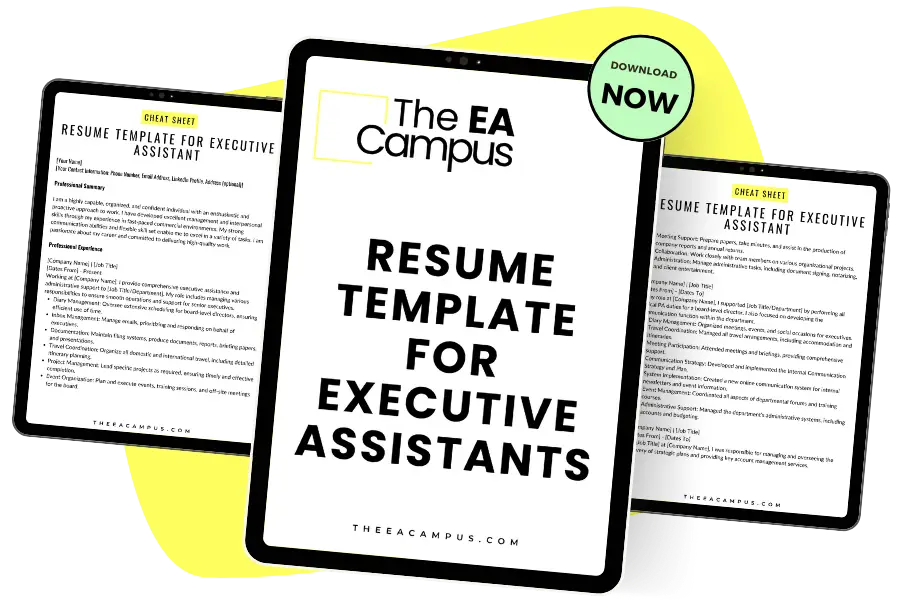
This template covers everything you need to get your resume in front of the right recruiters and employers. It is a free downloadable PDF; you can adapt it to create the perfect resume for your career history.
One of the biggest shifts we are seeing in 2026 is that skills are being valued more directly than tenure. Nearly seven in ten professionals say they would accept structured training instead of a pay rise, and in tech, that number rises to around 80 percent. That tells us something practical about how the market is thinking. Capability is being priced and assessed in a much more visible way than time served.
For us as EAs, this has real implications. Hiring managers are looking beyond how many years you have been in the role, the brand name of your employer, or whether your career path looks perfectly linear on paper. Those details still provide context, but they are no longer enough on their own. What carries more weight now is evidence of AI literacy, comfort with data, the ability to collaborate across functions, and strong operational thinking.
In interviews, you’ll be asked to talk through a complex situation you handled. The difference is in the level of detail you give. Saying, “I manage complex diaries,” does not tell a hiring manager much about how you think. Walking them through how you redesigned your Executive’s calendar structure, introduced structured triage rules, reduced meeting clashes by 30 percent, and protected strategic focus time gives them something concrete to evaluate. If you step back and ask what Hiring Managers really look for in Executive Assistants, the answer comes down to clear thinking, measurable contributions, and sound decision-making under pressure.
This is where skills-first hiring becomes very real for Executive Assistants. It comes down to the decisions you made inside the role and how you executed them. When you explain the reasoning behind your approach, what worked, what you adjusted, and the measurable outcome, you make your capability visible.
We have been talking about this for years. We cannot keep saying our best work happens behind the scenes or that our Executive does not fully see what we do. That may feel true in the moment, but it does not help us in a hiring market that demands evidence.
In 2026, invisible work does not convert into job offers.
We have to articulate it clearly, quantify it where we can, and demonstrate its value long before we sit in an interview room. That means tracking impact in your current role, documenting improvements you have made, and being ready to explain the business outcome of your decisions, not just the tasks you completed. That means quantifying outcomes where possible, being specific about impact, and showing clearly how our work improved the day-to-day reality for our Executive and the wider team. When you understand what Hiring Managers really look for in Executive Assistants, you stop describing your job and start demonstrating your value.
How you talk about your use of AI actually matters. This is part of what Hiring Managers really look for in Executive Assistants.
As EAs, AI literacy in 2026 is very practical. You need to know where AI genuinely saves you time and where it creates risk. You need to be comfortable using it and comfortable taking responsibility for what goes out under your Executive’s name. You also need to explain how it fits into your workflow, rather than treating it as a separate experiment on the side.
Hiring managers do not care about a long list of tools. They care about what changed because you used them. If you say, “I used Copilot to summarize board meetings and built a structured action tracker that reduced follow-up time by 40 percent,” that gives them something concrete to assess. It tells them how you think and what you improved.
At this stage, no one expects Executive Assistants to be building AI models. What they expect is confidence with the tools available, clarity about where they help and where they fall short, and the ability to weave them into daily processes. In reality, that might mean extracting actions from meetings, drafting communication more quickly, structuring reports, reducing repetitive admin, and sense-checking AI output before it reaches your Executive.
The Assistants who are standing out in this current market are explaining the outcome from their work and how AI is involved in the processess. They talk about reducing email triage time by 40 percent because they use Copilot and Outlook effectively. They talk about building a repeatable process that saved their Executive three hours a week by knowing how to prompt ChatGPT. So when we talk about AI literacy, we are really talking about connecting the tool to a business result and showing clearly how it improved the way you and your Executive work together. That clarity around outcomes is what Hiring Managers really look for in Executive Assistants.

Another area to consider when thinking about what Hiring Managers are really looking for in Executive Assistants in 2026 is how we handle change and work with others. Hiring managers are paying close attention to how you talk about shifting priorities, feedback, and uncertainty. They are listening to how you think when the plan changes, the Executive switches direction, or the business is in transition.
As EAs, we know this is our everyday reality. Leadership restructures, Executive role changes, mergers, and rebrands can all land on our desks with very little notice, and we are often expected to steady the ground beneath our Executive or keep everything moving along while everything is still shifting. We move from in-office to hybrid to fully remote support, sometimes within the same year (if not the same week). So when you are asked about adaptability, they are not looking for a polished story. They want to understand what was difficult, what you did to make it easier for you and your Executive, and what you would refine next time.
Saying everything went smoothly does not build credibility or likeability which is important.
Walking through what felt challenging, how you managed stakeholders, how you protected your Executive’s time, and how you kept communication open across the team gives them something real to assess and shows a real insight into how you operate.
At the same time, cultural fit has become more tangible. Hiring Managers are thinking carefully about how each new hire affects the team dynamic. They are considering whether your values align with how the business operates, whether you can collaborate across functions, and whether you contribute positively to the environment around your Executive. For Executive Assistants, emotional intelligence is central to this. That might mean mediating tensions between departments, handling sensitive Executive communication with care, or managing confidential matters with grace. It might also mean knowing when to push back respectfully and when to step in to calm a situation without adding further disruption.
In startup and scale-up environments, adaptability also includes understanding funding cycles and their implications for the business. If you have supported an Executive through seed funding, Series A or B rounds, or later-stage investment, talk about it.
Funding rounds affect hiring plans, reporting requirements, board communication, cash flow decisions, and often the overall mood of the company. An EA who understands that context and adjusts priorities accordingly brings a level of commercial awareness that hiring managers value really really highly.
Resilience, empathy, and self-awareness are not extras in EA hiring. They are part of the core capability expected from someone working closely with senior leadership. When you talk about these qualities in interviews, anchor them in specific situations. Explain what you did, how others responded, and what changed as a result. Again, you’ll see how the Hiring Manager responds differently when you can really article this.
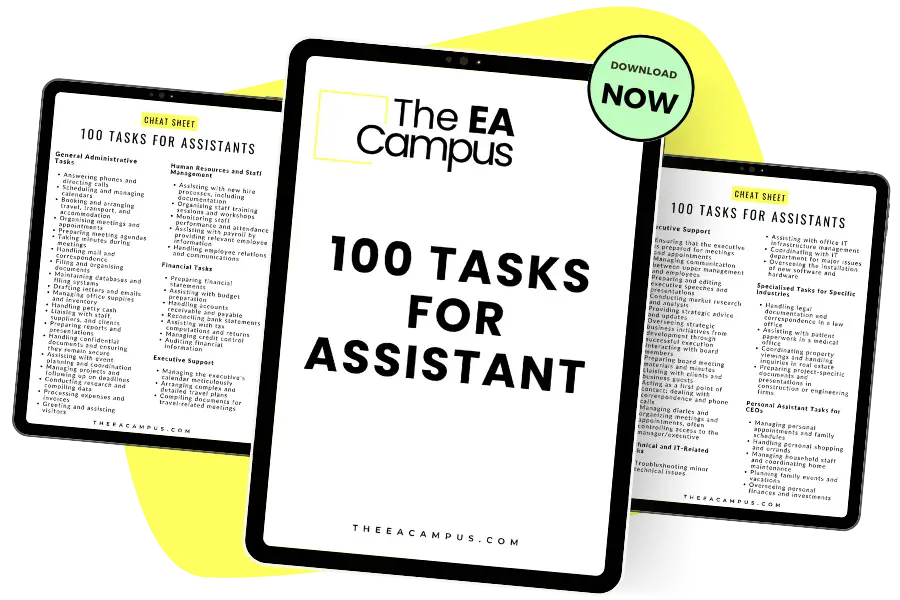
This List of Tasks for Executive Assistants Download helps you recall and record every task you handle, supports you in writing polished CVs and precise job descriptions, and recognises additional responsibilities you can undertake.
By 2026, virtual assessment is simply part of the process, and I know how frustrating that can feel. Five years ago, you might have had one interview and a follow-up. Now it can mean multiple video calls, task-based simulations, digital screening tools, and AI-assisted shortlisting before you even speak to a final decision-maker. It is a lot of effort, a lot of preparation, and sometimes you still do not get the role at the end of it. As EAs, we have to assume that at least part of our application will be evaluated through a screen before we ever sit in a room with someone, and that reality is not going anywhere.
That changes how we prepare. You need to be clear about what you did, why you did it, and what changed as a result, and you need to explain that in a logical order that someone else can follow without guessing. When you are asked to complete a task or talk through a scenario, it helps to slow down and explain your reasoning step by step, rather than jumping straight to the outcome. Hiring managers are listening for how you prioritize, how you manage risk, and how you communicate under time pressure.
At the same time, the broader hiring context is tightening. Many organizations are hiring less frequently, which means each role carries more scrutiny and each decision is examined more carefully. There is less appetite for risk and more focus on whether this hire will stand up to pressure over time.
For Executive Assistants, that raises the bar. It is no longer enough to demonstrate that you can manage tasks efficiently. Hiring managers are asking themselves whether they would trust you with strategic proximity to leadership, sensitive information, and moments of organizational change. They are considering whether you can operate with discretion, think ahead, and hold your ground when conversations become detailed or complex.
So when you approach interviews in 2026, treat them as thoughtful conversations rather than performances. Yes, you need to be prepared, but you also need to be specific. Prepare real examples with measurable outcomes and be ready to break them down clearly.
For example, be able to explain:
Avoid generic answers that could apply to any role. Walk through how you think, how you decide, and how you protect your executive’s time, reputation, and focus. In a market with fewer hires and higher stakes, that level of detail helps hiring managers see how you operate under pressure and whether they would feel comfortable putting you in close proximity to leadership.
If you are applying for roles in 2026, you need to be deliberate about four things: how you think, what you changed, how you use technology, and how you operate around senior leaders. When you step back and consider what Hiring Managers really look for in Executive Assistants, it comes down to clarity, evidence, and trust.
First, show how you think. Do not just list responsibilities. Walk through a real scenario. Explain what was happening, what information you had, what options you considered, and why you chose one route over another. Make it easy for someone to follow your logic without filling in gaps for you.
Second, be clear about what changed because you were in the role. Did you restructure a calendar to protect ten hours a month of strategic time. Did you reduce email backlog from three days to same-day responses. Did you tighten board preparation so materials went out 48 hours earlier. Be specific. Numbers help, but so does a clear before-and-after description.
Third, explain how you use technology in context. Not a list of platforms, but how they sit inside your workflow. How you draft faster without lowering standards. How you check outputs before they go to your Executive. How you decide when to rely on a tool and when to step in personally. That awareness tells a hiring manager you can operate independently without creating risk.
Fourth, describe how you function around leadership. How you handle confidential information. How you manage competing stakeholder demands. How you push back when something does not make sense. How you protect your Executive’s time without damaging relationships. This is where trust is built.
The process may involve more steps than it did five years ago. There may be more screening, more tasks, more conversations. Underneath all of that, the decision is still about confidence. The hiring manager is asking whether they would feel comfortable placing you close to strategic conversations, sensitive information, and high-pressure moments. When you understand what Hiring Managers really look for in Executive Assistants, you focus less on sounding impressive and more on being specific about the value you bring.
Your role in that process is to remove doubt by being concrete, detailed, and honest about the impact you deliver.
If you want practical support with this, from refining your CV to preparing structured interview examples and strengthening your LinkedIn profile, we have a free resource that walks you through it step by step. You can access the Assistant Job Search Accelerator here.
Share this article:
Join 30,000+ Assistants receiving our carefully crafted weekly newsletter packed with valuable tips, tricks, and insights tailored specifically for Assistants like you.