
How EAs shape company culture is something most of us could describe from memory, even if we have never put it in those words. Think about the last few weeks. You probably welcomed a new starter and made sure they had a laptop, a login and someone to have lunch with. You moved things around so your Executive could be at the all-hands in person. You rewrote an email that would have come across badly with the finance team. And you noticed that someone had stopped coming to the Monday meeting, and mentioned it at your next one-to-one with your Executive.
None of that appears in a job description, but all of it is culture, because culture is what people experience at work from one day to the next, and a surprising amount of that experience passes through the Executive’s office.
As EAs, we know this is part of our everyday reality. What tends to happen is that it gets filed under “being helpful” and never gets recognized as leadership, by us as much as anyone.
So in this post, we are going to look at how EAs shape company culture, where that influence comes from, and what to do with it, including when the culture isn’t a healthy one.
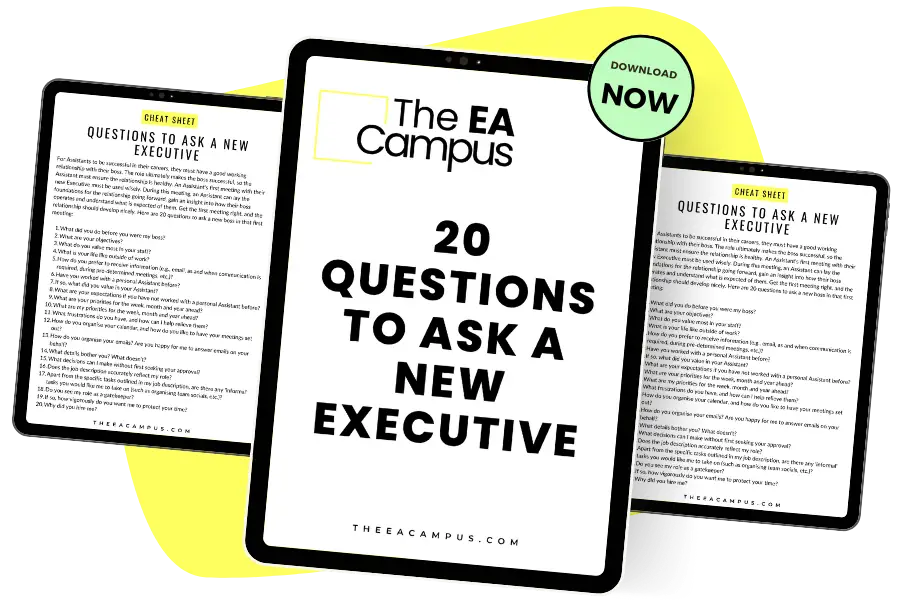
With our expertly crafted 20 Questions to Ask a New Executive Worksheet, you no longer have to play a guessing game with your Executive.
So where does that influence come from?
Most organizations agree that culture matters. Deloitte’s Core Beliefs and Culture survey found that 94% of executives and 88% of employees believe a distinct workplace culture is important to business success. But only 19% of executives and 15% of employees strongly believed their culture was widely upheld in their own organization, which is quite a gap.
The same survey asked what shapes culture. Executives pointed to financial performance and competitive pay. Employees pointed to regular, candid communication (50%), recognition (49%), and access to management and leadership (47%).
I’m guessing you can see where this is going?
Every one of the things employees named passes across an EA’s desk. We draft or edit a good share of what our Executive sends to their teams. We often know who deserves a thank-you before our Executive does. And we manage the diary, which gives us a big say in who gets time with leadership.
Then there’s the Gallup research showing that managers account for at least 70% of the variance in employee engagement across business units. Our Executive’s behavior sets the tone for the teams underneath them, and we are probably closer than anyone to how that behavior plays out across a working week, including the weeks when they are tired, overbooked and short with people.
So understanding how EAs shape company culture starts with accepting that we already do, whether we plan it or not.
Culture tends to be built from small moments that repeat week after week, and a lot of those moments are ones we organize, protect or let slide.
A rescheduled one-to-one. A slow reply to a new starter. A thank-you that never gets sent. A team meeting where the same few people always do the talking. On their own, none of these seems like much, but repeated over a quarter, they tell people what really matters around here.
So where do we make the most difference?
What gets protected and what gets moved first sends a message. If the team one-to-ones are always the first thing to go when the week gets busy, the team notices (usually long before anyone says anything). Agreeing with your Executive on which meetings are fixed is one of the simplest examples of how EAs shape company culture.
Many of us draft or sense-check the all-staff emails, the town hall slides and the messages that go out after a difficult announcement. For most employees, the tone of those messages is the culture, because it’s often the only direct contact they have with leadership.
Executives are busy, and good intentions about saying thank you tend to get lost. Keeping a running list of wins, names and dates, and putting it in front of your Executive before the leadership meeting, turns those intentions into something that actually happens.
Candidates, new starters and visitors often meet us before they meet anyone else, and we usually plan the offsites, team days and celebrations where culture becomes visible. That gives us a lot of say in who is included, who gets to speak and whether it feels worth turning up for.
So what do we actually do with all of this? Most of us don’t have a team reporting to us or a budget line labelled culture, and we don’t need either. What we need is a clear agreement with our Executive and a few habits that make the influence deliberate.
Find out what the culture is supposed to be.
Read the values, the last engagement survey results and whatever came out of the most recent leadership offsite. Then ask your Executive which of those matter most to them this year. You will probably find there are one or two they care about far more than the rest, and that is where to focus.
Agree on your remit with your Executive.
This is the step most likely to get skipped. Instead of saying, “Do you want me to sort out the team lunch this year?” try, “I’d like to take on a few things that would help the team feel more connected to you this year: a monthly coffee with new starters, a running list of wins for you to recognize at the leadership meeting, and protecting your one-to-ones so they’re the last thing to move. Can we agree on those, and on how you’d like me to flag it when something gets in the way?”
Can you see the difference? The second version gives your Executive a plan to say yes to, and gives you permission to hold the line later.
Protect the moments that matter.
Once you have agreed on what is fixed, treat it as fixed. If a one-to-one has to move, rebook it before you cancel it, and if it has moved twice, say so. Your Executive may not have noticed, and they will usually be glad you did.
Work with the other EAs.
If you support one member of a leadership team, the other Assistants support the rest. Agreeing on shared standards, like how all-staff communications are reviewed or how new starters are welcomed across every function, is how EAs shape company culture across the whole organization, and not only in one corner of it.
Bring some evidence.
When you raise something, bring a number with it where you can: attendance at the last three all-hands, the engagement score for a team, how many one-to-ones were moved last month. A number gives your Executive something concrete to respond to, and in my experience they are far more likely to act on it.

Sometimes the culture isn’t working, and it pains me to say it, but sometimes the problem starts in the office we support.
Research by Donald Sull, Charles Sull and Ben Zweig, published in MIT Sloan Management Review, found that a toxic culture was 10 times more important than pay in predicting whether employees would leave. The five elements they identified were cultures that were disrespectful, non-inclusive, unethical, cutthroat and abusive.
As EAs, we often see the early signs first. The tone of the emails we are asked to send. Meetings where people are spoken over or left out. Requests that sit uncomfortably with the values on the wall. Good people who start updating their LinkedIn profiles.
So what can we do? Sometimes it’s a private word, along the lines of, “I don’t think that email will come across the way you mean it. Can I soften the second paragraph?” Sometimes it’s raising a pattern at your one-to-one, with the evidence to back it up. Sometimes it’s a conversation with HR, particularly if someone could be harmed. And sometimes it’s recognizing that you can’t fix it yourself, and deciding whether this is somewhere you want to stay. Only you know where your line is.
Knowing how EAs shape company culture also means knowing the limits of that influence.
If you want to be more deliberate about how EAs shape company culture in your own organization, start small this month. Look at the last four weeks of the diary and count how many team one-to-ones were moved. Start a list of wins to share with your Executive before their next leadership meeting. Then have the remit conversation, and agree on what you are taking on.
Over time, this is how EAs shape company culture in a way that gets noticed: the teams feel more connected to leadership, new starters stay, and your Executive comes to rely on you for a read on the organization that they can’t get anywhere else. Which leads to a different kind of trust between you, and a very different conversation the next time your role is reviewed.
Share this article:
Join 30,000+ Assistants receiving our carefully crafted weekly newsletter packed with valuable tips, tricks, and insights tailored specifically for Assistants like you.