
Improving information quality is one of the most useful things we can do for our Executive, and EAs are already well placed to do it because so much of the information our Executive relies on comes to us before it reaches them. When the information we receive is accurate and complete, we can pass it on with confidence; but when it’s missing details or is out of date, we can pass those mistakes on to our Executive, and they may make decisions based on incorrect information.
Most of the time, nobody is doing anything wrong. People are busy, they send what they have, and it’s easy to forward something without checking it properly when your Executive needs it in the next ten minutes. But small mistakes and missing details add up, and they can lead to delays, extra questions and decisions that need to be made again.
The good news is that improving information quality mostly comes down to a few small habits in how you ask for information and pass it on to your Executive, and most take only a few minutes to start.
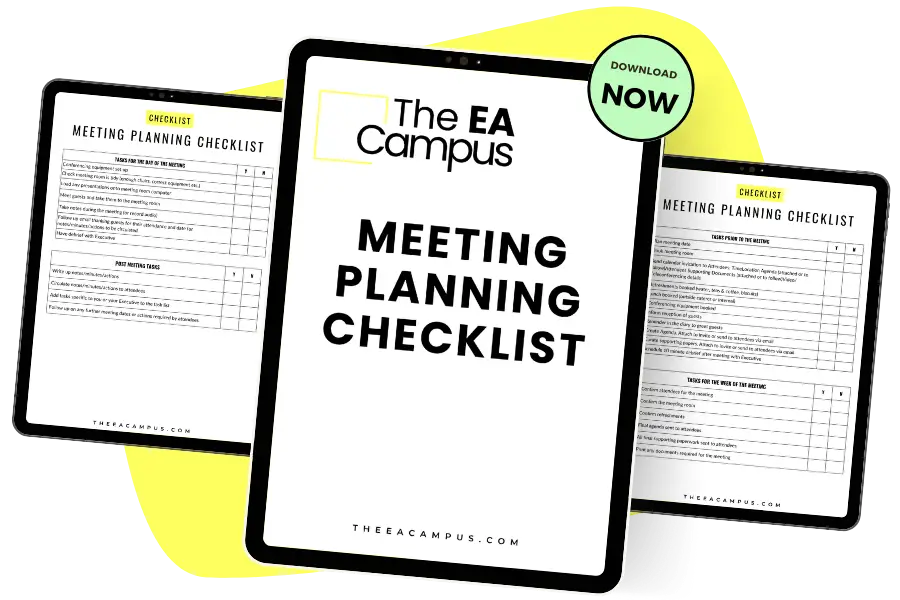
Ensure that every meeting is planned meticulously and that your Executive is prepared for every meeting they attend with our free Meeting Planning Template for Executive Assistants.
Information quality is a simple idea. Good-quality information is accurate, up to date, complete enough to act on, and in a format the recipient can actually use.
For EAs, information moves in two directions. It comes in to us from the people our Executive works with, and it goes out from us to our Executive in the briefings and updates we prepare. Improving information quality means paying attention to both. Ultimately, what we pass on to our Executives is only as good as what we received in the first place, unless we check it and correct any issues before it goes to our Executive.
Our Executive makes decisions every day based on the information in front of them, and the research suggests that information is often less accurate than it should be.
In a 2025 survey of 750 business and technology leaders at large global companies, carried out by Wakefield Research for the software company SoftServe, 58% said their company makes major decisions based on inaccurate or inconsistent data most or all of the time. That survey was about company data, such as sales figures and financial reports, but I think the same problem applies to a lot of the everyday information an Executive receives, such as briefings and project updates.
McKinsey found something related when it surveyed 1,228 managers about decision-making. On average, 61% said they spend most of their decision time ineffectively, and among C-suite Executives, the figure was 57%. There are lots of reasons for that, and information quality is only one of them, but it’s probably a big one. If our Executive has to go back and ask for missing figures, or check whether a report is up to date, before they can decide anything, that’s time they could have spent on the decision itself.
This is where improving information quality makes a real difference, because EAs are well positioned to spot missing or incorrect information before it reaches our Executive.
The easiest place to start improving information quality is with the information that comes to you, because you can avoid many mistakes and missing details if you’re clearer about what you’re asking for.

Once you’re confident in what’s coming in, the next step is improving information quality in what you pass on to your Executive.
One of the simplest habits for improving information quality is a quick check before anything goes to your Executive, and it can save a lot of time later. A few questions to run through:
This matters even more for anything created with AI, which can look well written but still contain mistakes. We’ve written more about this in our post on why filtering AI workslop is becoming a core EA skill.
If the same problem keeps coming up, like a weekly report that always arrives with figures missing, it’s worth speaking to the person who sends it instead of correcting it yourself every week. Have a friendly conversation with them, explain what your Executive needs and why, and agree what will change. It takes a little more effort at the start, but it saves you time every week after that, and this is where improving information quality starts to help you as much as your Executive.
It also helps to ask your Executive for feedback every now and then. A simple question like “Did that briefing give you what you needed?” tells you what’s working and what isn’t, and after a few of these conversations you’ll know exactly what they need from you, which makes improving information quality easier with every briefing you prepare.
If you’d also like to agree how you, your Executive and their team share information with each other, our post on creating communication principles is a good place to start.
Improving information quality takes a little extra time at each step, but it saves time for both of you, and your Executive starts to trust that whatever reaches them from you is accurate and ready to use.
Share this article:
Join 30,000+ Assistants receiving our carefully crafted weekly newsletter packed with valuable tips, tricks, and insights tailored specifically for Assistants like you.